
Business Opportunities Hiding in the ‘Negative Spaces’ of Our Rural Landscapes
Noticing as revelation
In my first month in the United States in 1992, I read “Staple Yourself to an Order,” a thought-provoking business strategy article published in the Harvard Business Review by Benson P. Shapiro, V. Kasturi Rangan, and John J. Sviokla.
The authors argued that executives and managers who want to gain a true understanding of their company’s internal processes in serving customers should quite literally “staple” themselves to a customer order, tracking it through every stage of the journey, from the initial request and processing phases to delivery and post-sale support.
As an executive and Managing Director of Dr. Mpumelelo Sati, Ph.D, this is exactly what I did last week.
Almost a month ago, I was approached by a client from the Netherlands, through a mutual friend, to request my board membership and training services. To verify and better understand certain aspects of the assignment, last week I travelled to the town of Thabazimbi to conduct on-site assessments and gather first-hand information.
Although I had travelled to within 30 kilometres of Thabazimbi before, it was my maiden visit to the town itself. Throughout my week-long journey, I attentively read the local landscape, searching for the ideas that lay hidden within its “negative spaces”, waiting to be discovered.
I noticed that due to El Niño the Bushveld is experiencing the throes of “green drought.”
According to Jamie Pepper of Pepper Pastoral, “A ‘green drought’ is a deceptive environmental condition where the landscape, hills, and fields appear lush, green, and healthy on the surface, but the underlying soil, deep root zones, and water systems (like dams and rivers) remain severely dry.”
According to Wikipedia, “A negative space is the empty or unoccupied area that surrounds and lies between the main subject (the positive space) of an artwork, photograph, or design.” For example, the white right pointing arrow between the “E” and “x” of the FedEx logo, in contrast to the orange letters around it.
The first glimpse into the landscape’s “negative space” appeared shortly after passing through the North West town of Brits. There stood Pronk Afrikaners, a familiar farm I had visited before, yet on this journey it revealed itself in a new light. It rekindled my interest in veld-raised beef from indigenous breeds.
Many years ago, when Dr Pieter de Kock, the owner of the farm, served as President of the Afrikaner Cattle Breeders’ Society, I visited his family to learn more about his Afrikaner cattle. As a descendant of the Khoikhoi people, I regard this indigenous breed as an important part of my own heritage as well.
I liked Pieter the very moment I shook his hand and I still do. Despite the deeply disturbing apartheid era flag that hanged in the Lapa where we sat and talked, I still bought two class AB slaughter animals to test the Ancestral Foods idea that I was contemplating at the time.
In the spirit of tolerance, I recognized that the flag holds cultural significance within Pieter’s Voortrekker tradition, of which he serves as a proud custodian.
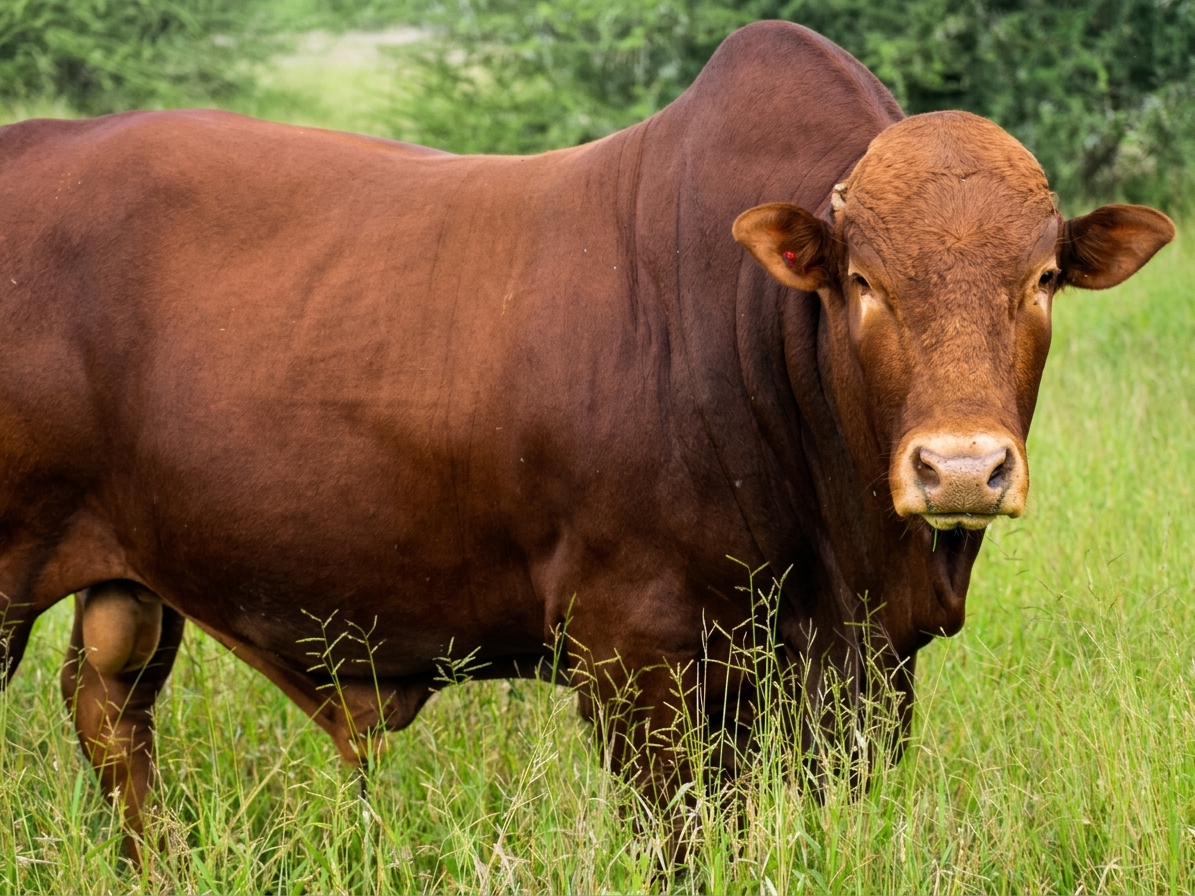
I was also drawn to Pieter’s Afrikaner cattle, not only because they were raised naturally on the veld on the outskirts of his hometown of Thabazimbi, but because the breed possesses qualities that set it apart from most other cattle in South Africa.
The Afrikaner cattle are renowned for producing fine-grained, high-quality beef and are recognized for carrying a rare dual tenderness gene, a characteristic that contributes to the exceptional eating quality of their meat. This was precisely the kind of competitive advantage I needed to test the concept.
A heritage breed capable of producing fine-grained, high-quality beef with exceptional tenderness offered a distinctive value proposition, one that could not easily be replicated by conventional beef producers.
The second piece of a “negative space” that caught my attention soon after passing the Pronk Afrikaners farm was the vast expanse of wheat and barley fields stretching far as the eye could see on the horizon.
Unknown to me at the time, there are occasions when those grains can only be sold as livestock feed, often at prices below their cost of production. Sometimes, farmers contracted to supply a national beer brewing company have entire consignments rejected for failing to meet specific quality specifications. In such cases, feeding the grains to livestock becomes the only viable outlet.
Talk about being compelled to farm at a loss.
Hearing about this conundrum from a local accountant the following morning suddenly took me back to an inspiring conversation I had with Kevin Morse in 2023. That year, a mutual friend, Spencer Beebe of Portland, Oregon, drove me to Washington State to meet Kevin Morse at Cairnspring Mills, an artisan stone-milled flour producer, based at the Port of Skagit.
Disheartened by watching family-owned wheat farms in the region struggle under the pressures of commodity markets, Kevin partnered with the Breadlab at Washington State University and Pacific Northwest farmers to cultivate flavourful, regeneratively grown wheat. The resulting flour is sold primarily to bakers seeking quality, locally sourced ingredients. The visit proved far more consequential than I could have imagined at the time.
What began as a simple introduction evolved into a fascinating exploration of grain value chains, regional food systems, and the opportunities that emerge when entrepreneurs learn to see value where others see constraints.
During our visit to the Island Grown Farmers Cooperative (IGFC), a full-service processing and retail shop known as Northwest Local Meats, also at the Port of Skagit, the operators of the meat business, reminded me of the value mobile slaughterhouse to create the local connection between nutrition filled beef and tasty bread.
With South Africa showing a growing interest in mobile slaughterhouse, now is the time for rural town like Thabazimbi to notice food processing related business opportunities combining products that are already grown locally such as wheat, red meat and poultry to feed local people and the visitors to the 40 plus private lodges in the Marakele National Park and across the Bushveld.
My research suggests that some of the most persuasive examples of this approach can be found in small and medium-sized enterprises, both in South Africa and abroad. Ventures such as Laluka Farm in Vaalwater, Cairnspring Mills, Old Salt Co-op in Helena, Montana, and Chimacum Valley Grainery demonstrate how private patient capital, combined with impact funding, can be harnessed to build resilient and locally rooted enterprises.
To me, this is how we take the lead: by combining our resources, knowledge, and wisdom to create rural economic opportunities, generate shared prosperity, expand youth employment, and strengthen the resilience of both the rural landscapes we call home and the communities that depend on them.
If upon reading this newsletter you find yourself in agreement with my reflections, I would welcome hearing your own thoughts on these ideas.
Get The Herd Book every Sunday
One piece a week from Dr. Sati, in your inbox on Sunday morning.